

If you live in Germany, you can skip this portion because you’ve lived through this already. But if you don’t, I want to share a little preview of what German bureaucracy looks like for an Ausländer (foreigner). I have EU citizenship so I’ll preface this by saying my experience is privileged and far easier than someone who requires a resident permit or certain salary-tiered job to stay in the country.
Germany is famous for their nonsensical bureaucracy. Most of it is done in-person or by post. Very few things are digital and the waiting times for mandatory, in-person appointments come with 3-4 month long waiting periods. For example (oder zum beispiel), when you move to Germany, you’re required to register your apartment at the local Bürgeramt (citizens office). In order to do this, you must have a form signed by your landlord confirming your residence. But if you’re not from Germany and require a visa to live or work here, this is where it gets tricky. Most landlords require you to have a visa before they’ll rent you an apartment. But you need to be registered in order to get a visa. Do you see what I’m saying here?
Like any government institution, you can assume you’ll be missing a piece of paperwork, a signature, a date or proof of something once you arrive at the appointment. Similar to the DMV, you sit on standby far past your scheduled appointment time in a horribly fluorescent-lit, sad little waiting room. You develop a Pavlovian response to the bell dinging thinking this is finally your moment—the moment where you, as a grown adult, will be dressed down by a disgruntled worker on account of forgetting to fill out one line of a gigantic document in your second language. This is the norm but on occasion, you get lucky and have a pleasant experience. Let’s shift the focus to that aspect, yeah?
It’s taken me quite a bit of time to register my apartment in Berlin but the circumstances were out of my hands. I finally got an appointment and registered my existence in the city, only a year and a half after feeling settled. When he stamped my registration paper he said “Welcome to Berlin” and laughed because it was backdated to June 2023. Nevertheless, the appointment and interaction was quick and painless.
And just like that, I was officially a Berliner.
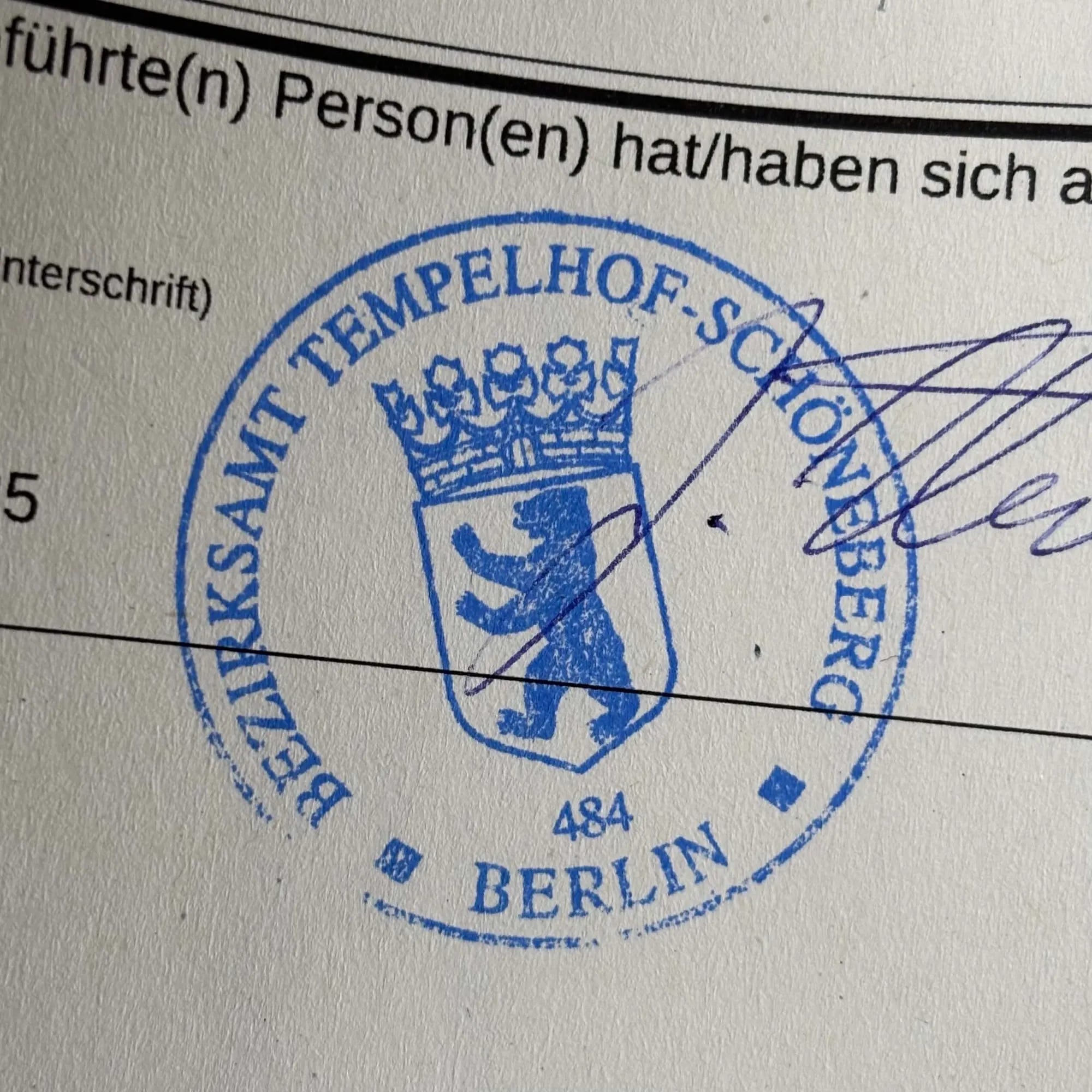
Rathaus Schöneberg
It was reported that over 1 million Berliners stood on the streets to welcome JFK to Berlin when he visited in 1963. He drove past the landmarks including the Brandenburger Tor, finally landing in Schöneberg, my neighborhood, which is in West Berlin. He delivered his infamous speech on the steps of the Schöneberg Rathaus (City Hall) where he talked about the reunification of Germany and what freedom meant to those oppressed by the wall. It was there that he said the famous phrase “ich bin ein Berliner” to the Western Germans in attendance.
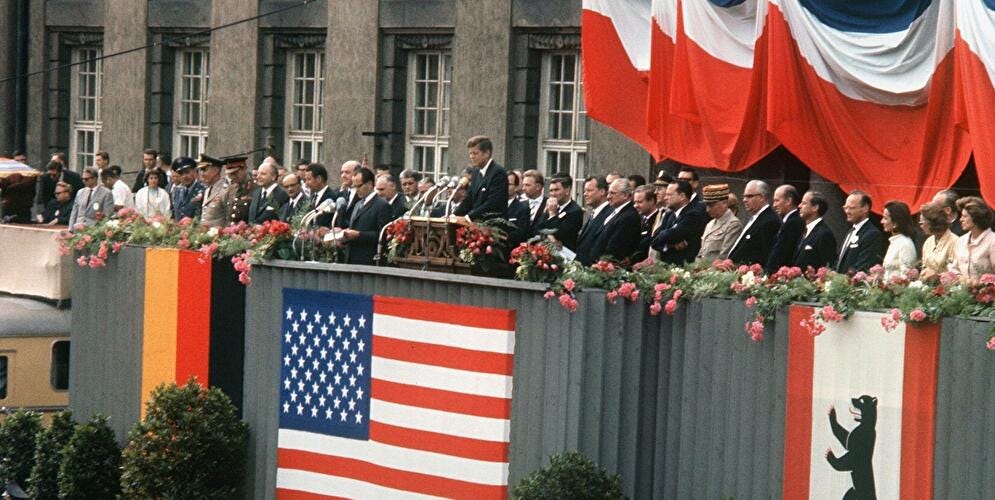
“Freedom is indivisible, and when one man is enslaved, all are not free. When all are free, then we can look forward to that day when this city will be joined as one and this country and this great Continent of Europe in a peaceful and hopeful globe. When that day finally comes, as it will, the people of West Berlin can take sober satisfaction in the fact that they were in the front lines for almost two decades.
All free men, wherever they may live, are citizens of Berlin, and, therefore, as a free man, I take pride in the words "Ich bin ein Berliner." -JFK, June 26, 1963
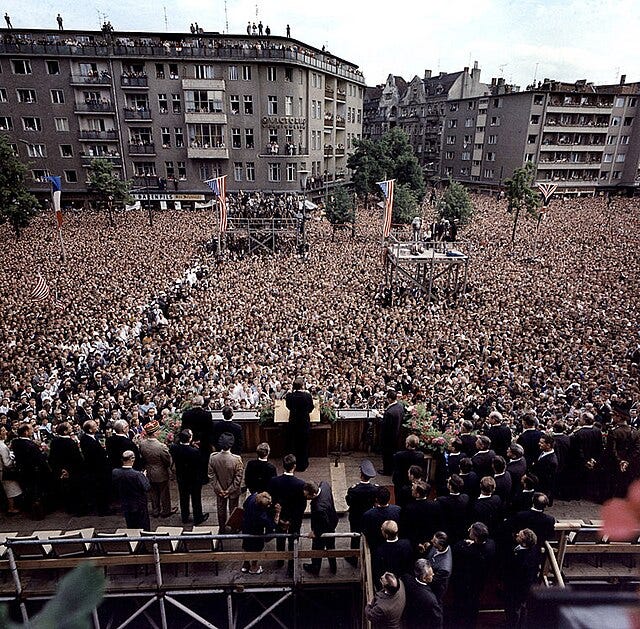
Now, from this point of view, you can see my neighborhood. The Rathaus backs up to a park where I walk Russ regularly or go for runs. This plaza filled with people is now named after JFK. Coincidentally, this is also the building where I have to do all my administrative appointments such as registering my official residence. Every time I’ve walked through this parking lot, whether it be to visit the Sunday flea market, cut through to the park with Russ or show up for an appointment, I can’t believe this is the place where JFK stood and gave his “era-making” speech. It’s hard to believe that the wall would continue dividing the country for another 26 years after that day. It’s even harder to believe that JFK was assassinated only months after he stood on these steps in Berlin.
Urban Legend
Maybe you know or maybe you don’t but it was meant to be quite significant that JFK said the words “Ich bin ein Berliner” not only to speak German to the German people, but also to signify unity and support. However, years later it was singled out that by using the article “ein” the translation is correct but because languages are complex, a Berliner is also the word for a jelly-filled donut. Nearly 25 years later, the New York Times amongst others reported that Germans laughed at him or interpreted his famous line as “I am a jelly-filled donut.” Historians have since debunked this myth and confirmed that the spectators of that speech did not laugh or hear it this way.
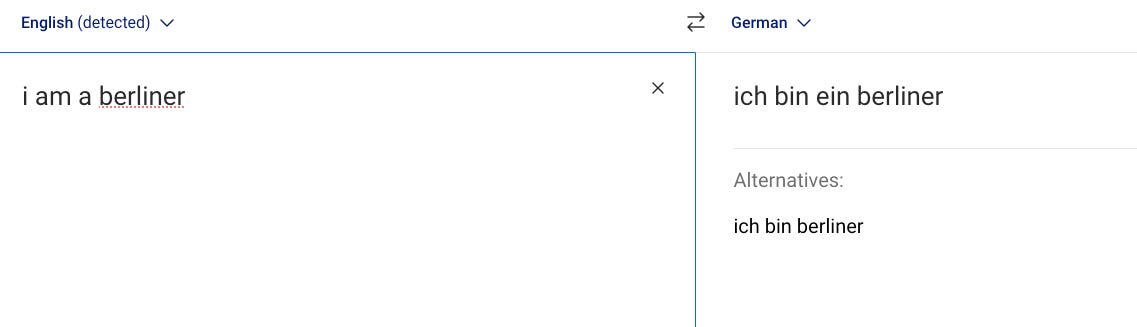
In my research, I learned the myth gained traction in the 80’s from a Newsweek citation and an editorial piece in the New York Times titled “I am a Jelly-Filled Doughnut.” Since then, it’s been circulated world-wide and historians frown upon this sensationalism as it takes away from the impactful sentiment of the speech. At the time, it was a groundbreaking speech and meant to boost morale for a recently divided Germany, more specifically for Berlin, a city with a wall running throughout the middle.
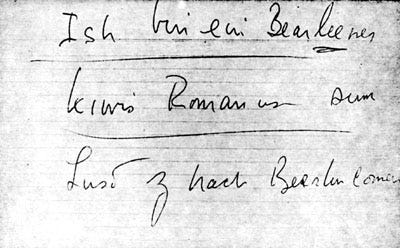
Now think about this for a second… one of the most well-known speeches from the Cold War era has been often reduced to a fictional language blunder? For someone who is also learning German, this is particularly frustrating. Of course I’m not standing in front of thousands of people giving an important speech (thank God) but context/nuance play a huge part in the language learning process. JFK even wrote down the phonetical pronunciation on a piece of paper so he’d get it right. I feel that. It’s humbling and takes time to understand the complexities of a language and I’m not nearly there yet. Anyway, what he said was grammatically correct and he packed quite a punch with that line. I guess it’s just a shame that this is the takeaway for people of our generation. Until I did my research, you could also include me in that group.
Back to my story, so there I was, an official Berliner—in both meanings of the word (lol). No seriously, registering my existence here was a huge weight off my shoulders and a big to-do crossed off my list. Next up was registering my brother, Ryan. We live in the same country, city AND building. Isn’t that wild? He desperately needed to register his place so he could get a tax-ID and begin working in Germany.
We marched up the steps, the same steps where JFK gave his speech, early on a Monday morning. Ryan couldn’t get an appointment for months so we decided to show up at 8am and beg for mercy. In my head I kept practicing what I’d say as his official translator.
“Hallo und Guten Morgen. Das ist mein Bruder. Er hat kein Termin aber es ist sehr wichtig für ihn, seine Wohnung anzumelden. Er hat einen neuen Job und keine Steuernummer. Ist das möglich?”
In essence, this is my brother. He doesn’t have an appointment but it’s very important for him to register his apartment. He has a new job and doesn’t have a tax ID number. Is it possible?
We approached the room and woman outside asked if we had an appointment. I responded no and she gave me the “good luck” look. We stood in line and after a few minutes, it was my time to shine. We made our way to the front and I said my piece. I’m pretty sure I said “neue” instead of “neuen” and “kein” instead of “keine” but the point was all the same. As anyone learning a language can relate, it’s a real accomplishment when someone doesn’t switch to English on you. At times, it’s a relief when they do and you’re underwater. Other times, it’s demotivating and doesn’t allow you to practice. While usually meant as a nice gesture, it can feel dismissive or impatient on the receiving end. In some cases, I’ve kept speaking German even when they switched to indicate I was trying. In this instance, he spoke with me in German the whole time despite it being far from perfect.
He gave us an appointment and told us to take a seat. Within 20 minutes, we were called and showing my brother’s paperwork to our case worker. At the end, they stamped his paper and welcomed him to Berlin. Feeling proud of myself for speaking German and happy for Ryan as he was officially registered, we stepped outside onto the steps and he said “ich bin ein Berliner.”
Perfectly fitting.